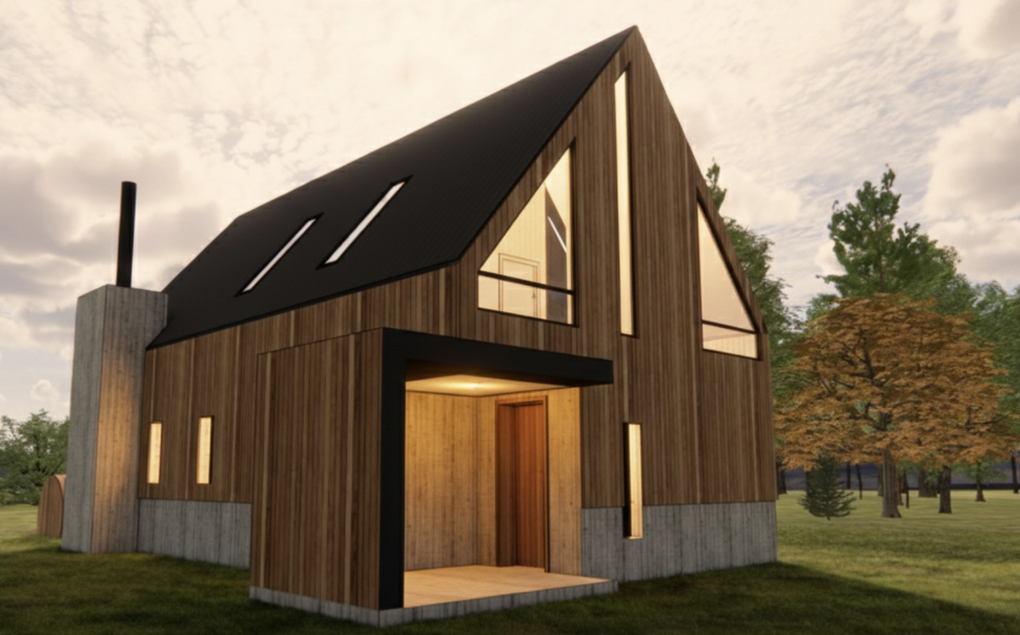
The best buildings don't look like they were placed on a site. They look like they grew from it. That's not a romantic notion; it's a design standard. Site-responsive architecture starts from the premise that every piece of land has a logic: a topography, a climate, a material culture, a view. The architect's job is to read that logic carefully and respond to it honestly. When that happens well, the result is a building that feels inevitable, as if nothing else could have stood in that spot.
Linebox Studio recently developed three distinct cabin concepts for a multi-unit retreat development on a 132,000+ sq/m waterfront lot along the Gatineau River near Mont-Sainte-Marie, Quebec. Same site, same zoning, same material palette - three very different answers to the question of what it means to belong to a place. One concept plays with vertical contrast: a steeply pitched gabled roof rising from a cantilevered concrete base, cedar-clad and dramatic. Another goes tall and lean, a vertical vernacular expression with a soaring two-storey interior. The third goes horizontal - a long, low single-storey form that follows the landscape rather than competing with it.
What unites all three is a commitment to architecture as a response rather than an imposition. The green roof that slows the wind and softens the silhouette. The earth-bermed wedge that pulls daylight deep into the section. The covered threshold that stages the transition from outside to in — compression, then release.